Sunday, 18 January 2015

#26 Osmose (Français)


Osmose

Qu'est-ce que l'osmose?
L'osmose est le mouvement de molécules d'eau d'une région de concentration élevée (solution diluée) à une zone de faible concentration (solution concentrée) à travers une membrane semi-perméable.

Quand et pourquoi l'osmose se produit-elle?
L’osmose se produit lorsque l'eau autour d’une cellule est plus concentrée que l'eau à l'intérieur du cytoplasme de la cellule. Dans ce cas, le cytoplasme va se pousser contre la paroi de la cellule en raison des nombreuses molécules d'eau qui entrent dans la cellule. Elle peut également se produire dans le sens opposé, lorsque l'eau à l'intérieur de la cellule est plus concentrée que l'eau autour de la cellule. Lorsque cela se produit, le cytoplasme va alors s’éloigner de la paroi cellulaire, comme il a diminué en raison des molécules d'eau quittant la cellule. Cela se produit car les molécules d'eau vont se déplacer d'une zone de haute concentration vers une zone de faible concentration.

Exemple d’une expérience d’osmose :
Un exemple clair pour montrer comment marche l’osmose, serait une expérience de pommes de terre. Dans cette expérience, nous utilisons trois morceaux de pommes de terre, coupés en fines tranches qui ont la même masse, et qui seront chacun placé dans différentes solutions de concentration de sucre. Pour savoir où l'osmose se produit, nous avons pesé la masse de chaque tranche de la pomme de terre avant de commencer l'expérience, et nous allons peser nos tranches de pommes de terre après l'expérience à nouveau pour vérifier  s'il y avait une différence de masse et donc si l'osmose s’est produite. Le premier morceau de pomme de terre est placé dans une concentration de sucre de 0 molaire, la seconde à une concentration de 0,5 molaires et la troisième à une concentration de 2 molaires. La théorie de cette expérience était que le morceau de pomme de terre la concentration de sucre est de 0 molaire serait celle se produirait l'osmose. Le morceau de pomme de terre la concentration est de 2 molaires serait celle où les molécules d'eau sortiraient des cellules de pommes de terre pour aller dans la solution. Nous avons également pensé que le morceau de pomme de terre avec 0,5 molaires ne changerait pas de masse parce qu'il y aurait équilibre.
 

Notre hypothèse est que dans l'eau pure, la masse de la pomme de terre augmente et quand la concentration est plus élevée, la masse diminue.
Nous avons commencé par
peser nos trois morceaux de pomme de terre et ensuite
enregistré leur masse. Après cela, on a placé chaque morceau de pomme de terre dans les trois solutions de sucre et on les a laissés dans la solution pendant 25 minutes. Après avoir attendu 25 minutes, nous avons sortis les morceaux de pommes de terre de la solution et  nous avons de nouveau pesé chaque morceau de pomme de terre et nous avons enregistré leurs masses.


Nos résultats étaient comme prévu:

La concentration de sucre (molaire)
Temps (minutes)
La masse avant l’expérience (grammes)
La masse après l’expérience (gramme
s)
La différence de masse
0
25
3,19
3,47
+0,28
0,5
25
3,04
2,96
-0,08
2
25
3,05
2,62
-0,43


Nous avons donc conclu notre expérience en disant que lorsque le morceau de pomme de terre est dans une solution de sucre élevé, il perdra une partie de sa masse et quand un diffèrent morceau de pomme de terre est dans une concentration de sucre faible, sa masse augementra. Cette augmentation et diminution de la masse est donc ce qui prouve que l'osmose se passe dans les cellules.

#25 Osmosis (English)


Osmosis

What is osmosis?
Osmosis is the net movement of water molecules from an area of high water concentration (dilute solution) to an area of low water concentration (concentrated solution) through a partially permeable membrane.

When/Why does osmosis occur?
Osmosis happens when the water surrounding a cell is more concentrated than the water inside of the cell’s cytoplasm. In this case the cytoplasm will push against the cell wall due to the numerous water molecules coming into the cell. It can also happen vice versa, when the water inside of the cell is more concentrated than the water surrounding the cell. When this happens the cytoplasm will then push away from the cell wall as it has shrunk due to the water molecules leaving the cell. This happens due to the water molecules moving from an area of high concentration to an area of low concentration.
Osmosis Lab example:
A clear example to show the way osmosis works would be the ‘Osmosis in Potato cells’ experiment. In this experiment we use 3 pieces of potato, cut into strands which are about the same mass, which will each be placed into different sugar concentration solutions. To find out where osmosis occurred we weighed the mass of each strand of potato before starting the experiment and we would weigh our strands of potatoes after the experiment again to see if there was a difference in mass and therefore if osmosis had occurred. The first piece of potato will be placed in a sugar concentration of 0 molar, the second in a concentration of 0.5 molars and the third in a concentration of 2 molars. The theory to this experiment was that the piece of potato in the 0 molar sugar concentration would be the one where the water molecules will go inside the potato cells and the piece of potato in the 2 molars sugar concentration would be the one where the water molecules would leave the potato cells to go into the solution. We also thought that the piece of potato which would go in the 0.5 molar solution would stay more or less the same because there would be an equilibrium.

Our hypothesis was that in pure water, the mass of the potato would increase and that in high solute concentration, the mass will decrease.

We started out by taking our three pieces of potato and weighing each one and we then recorded their mass. After this, we placed each piece of potato into the three solutions of sugar and left them in the solution for 25 minutes. After waiting 25 minutes we took the pieces of potato out of the solution and again weigh each piece of potato again and record their mass.
 

Our results were as expected in our otheory: 

Sugar concentration (molar)
Time (minutes)
Mass before experiment (grams)
Mass after experiment (grams)
Mass increase and decrease (grams)
0
25
3.19
3.47
+ 0.28
0.5
25
3.04
2.96
- 0.08
2
25
3.05
2.62
- 0.43


We therefore concluded our experiment by saying that when the piece of potato is in a high sugar solution, it will lose some of its mass and when it is in a low sugar concentration, it will gain mass. This increase and decrease of mass is therefore what proves osmosis happening in cells.

Tuesday, 9 December 2014

#24 Why do we cry while chopping onions? (English)


Why do we cry while chopping onions?

The tears you shed when chopping onions aren't emotional ones. That leaves two other categories of tears: basal and reflexive. Basal tears are the ones that hang around our eyes and eyelids to act as a lubricant so that leaves us with the final option: reflex tears. The lachrymal glands above the eyelids regulate the release of tears. In the case of reflex crying, an external irritant, such as dust or smoke, triggers nerve endings in the cornea to communicate with the brain stem. The brain registers the irritation in the eye then alerts the lachrymal gland to stimulate tear production to flush away the invader.  Since onions are part of the plant genus Allium they absorb sulfur in the earth, which helps form a class of volatile organic molecules called amino acid sulfoxides. These sulfoxides trigger tears when onions are chopped. As we chop up an onion, it releases lachrymatory-factor synthase enzymes. These catalysts cause the chemical chain reaction that ends with you tearing up. These enzymes react with the sulfoxides and convert them into sulfenic acid. Sulfenic acids are highly unstable and rearrange into a compound called syn-propanethial-S-oxide. When syn-propanethial-S-oxide enters the air around our faces and approaches our eyes, it evokes the reflexive tear response. Multiple nerve endings in the cornea register the sensation of the syn-propanethial-S-oxide as a substance that could harm our eyes, therefore the brain stem phones the lachrymal glands and the tears commence.

Friendly tip:
Chew gum while you chop onions! J

#23 Borborygmi (English)


Why do our stomachs growl?

Stomach growling can be explained by a closer look at how the digestive system functions. The digestive system is essentially a long tube that starts at the mouth and ends at the anus. This tube connects with the various organs and passages that play important roles in digestion. The digestive system moves food through peristalsis. This process can be defined as waves of muscle contractions that move and push the contents continually downward. In addition to moving your meal along its digestive path, these contractions also help churn food, liquid and different digestive juices together. Stomach growling is a result of this process. Most people believe that when your stomach growls it means you’re hungry, however this is not the case. It just so happens that growling can occur at any time but it just becomes quieter when there’s food in your stomach or small intestine. If this is so, then why are the muscle contractions that digest food happening if your stomach is empty? The reason has to do with hunger and appetite. About two hours after your stomach empties itself, it begins to produce hormones that stimulate local nerves to send a message to the brain. The brain replies by signaling for the digestive muscles to restart the process of peristalsis. First, the contractions sweep up any remaining food that was missed the first time around and then the vibrations of an empty stomach make you hungry. Muscle contractions will come and go about every hour, generally lasting 10 to 20 minutes, until you eat again. However if you are experiencing excessive grumbling it may be a sign of an upset stomach


Fun fact:

The technical name for the noises made by a grumbling stomach is borborygmi. The term comes from the Greek word borborugmos, an example of onomatopoeia. Borborygmi illustrates what stomach growling might sound like in word form.

#22 Why is the human brain wrinkled? (English)


Why is the human brain wrinkled?

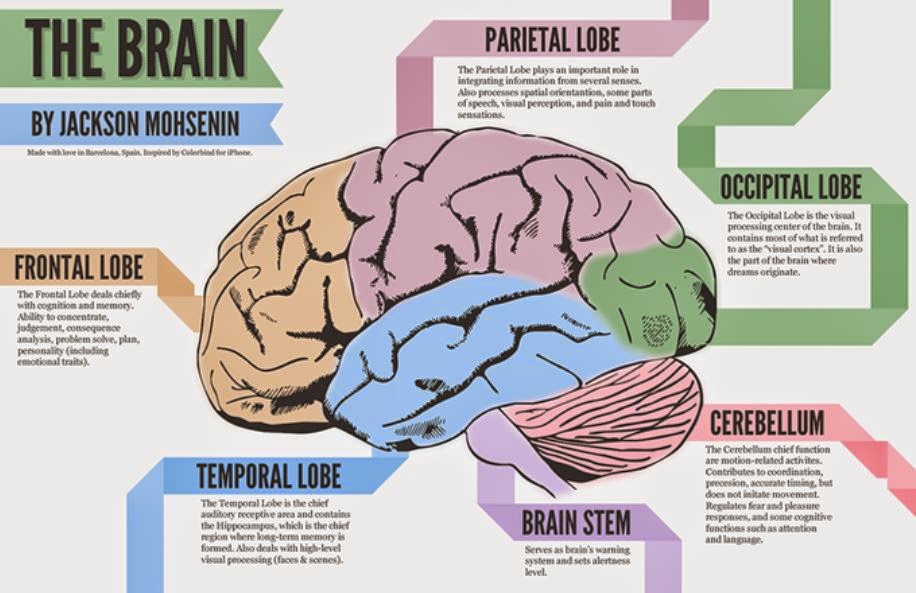
Researchers found that the particular pattern of the ridges and crevices of the brain's convoluted surface (gyri and sulci) depends on two simple geometric parameters: the gray matter's growth rate and its thickness. Along with these physical constraints, genes also have a role in determining the brain's shape. Genes regulate how neurons increase rapidly and migrate to their destinations. All mammal species have similar layering in the cortex (brain’s outer layer,) but only large mammals have one that is folded. A folded brain surface has a greater surface area than a smooth one, which means a greater power for processing information. The white matter of the brain is made up primarily of axon tracts, the long, spindly appendages of some brain cells, whereas the gray matter is mostly neuron cell bodies and non-neuron brain cells called glial cells. 

Did you know that?
·        Lack of oxygen in the brain for 5-10 minutes leads to permanent brain damage
·        Your brain keeps developing until your late 40s
·        Your brain uses 20% of the total oxygen and blood in your body
·        When awake the human brain produces enough electricity to power a small light bulb
·        60% of your brain is fat
·        The smell of chocolate increases theta brain waves which triggers relaxation
·        When you learn something new the structure of your brain changes
 
 
This is a comparison with a typical brain and Einstein’s brain. The absence of the parietal operculum from Einstein’s brain may have allowed a part of his brain to grow wider than normal. Also, his lower parietal lobe (which is responsible for mathematical thought, visuospatial cognition, and imagery of movement) was 15% larger than average. Then, what is the parietal oerculum? The parietal operculum processes information from many of the senses like touch.


Sujin and Aoife's Joint Project #2

#21 What happens when you swallow gum? (English)


What happens when you swallow gum ?


What is gum made of?

 Gum was originally made from the latex sap of the sapodilla tree. This sap was called chicle. There are other natural gum bases: sorva and jelutong. Sometimes beeswax or paraffin(used to make candles) is used as a gum base. After World War II, synthetic rubber to replace most natural rubber in chewing gum. The chewing gum contains sweeteners, flavouring, and softeners. Softeners are ingredients such as glycerin or vegetable oil. They blend other ingredients and help prevent the gum from becoming hard or stiff.
Latex Sap of the Sapodilla Tree
Sorva


What happens when you swallow gum?

Have you ever wondered what really happens when you swallow gum? Then you’ve probably heard that it stays in your stomach for SEVEN years! Right? Wrong.

Your digestive system treats the gum like any other food. Some parts of gum are broken down by the digestive juices in your stomach. Any nutrients your body can use are saved. The rest is pushed through your digestive system.  

However, there is one part of gum that cannot be digested, the gum base. Gum base consists of chemicals that scientists use to make the gum chewy. These chemicals resist digestion and instead the body moves it along the digestive process until it is eventually eliminated. It would usually take about two days to digest and eliminate any gum you have swallowed.

Even though swallowing gum is harmless, you should try not to as swallowing large amounts of gum on a regular basis could lead to digestive problems.
 
Sujin and Aoife's Joint Project #1

#20 Human Nutrition (English)


HUMAN NUTRITION


Nutrition is the taking in of nutrients which include organic substances and ions, containing raw materials or energy for growth and tissue repair, and then absorbing and assimilating them. A balanced diet should consist of all six nutrients including fiber. These nutrients should be in reasonable proportions. The total energy content of the food should be about the same as the total energy the person uses each day. Energy is measured in kilojoules.  

Humans need the following nutrients:
 
- Carbohydrates

-  Fats

-  Proteins

-  Vitamins

-  Minerals

-  Water

Why do humans need nutrients?

1.       Energy

2.       Building materials to build the cells in our body

3.       To provide us with chemicals used to help metabolic reactions

Carbohydrates
The carbohydrates with the smallest and simplest molecules are sugars. A sugar molecule contains three elements – carbon, hydrogen and oxygen. Glucose is an example of a simple sugar (monosaccharide) meaning it is made up of a single ring of carbon atoms. Complex sugars (disaccharides) are sugars with bigger molecules made up of two rings joined together. Sugar molecules can link together to form huge molecules made up of chains of hundreds of sugars. These big molecules are known as polysaccharides and include starch, glycogen and cellulose.

Carbohydrates provide us with energy. The carbohydrate molecules that we eat are taken into every cell in our bodies in the form of glucose. Inside these cells the energy in the glucose is released and changed into a form that our cells can use. This process is called respiration.

Proteins
Proteins are made up of many small molecules called amino acids. Amino acids contain five elements. These are carbon, hydrogen, oxygen, nitrogen and sometimes sulfur.

Proteins are needed to build new cells so they are important for growth and repair. They build new tissues, antibodies, enzymes, hormones and other compounds.

Fats
Fats are sometimes known as lipids. Fats that are liquid at room temperature are known as oils. A fat molecule is made up of two kinds of smaller molecules – glycerol and fatty acids. Like carbohydrates, fats contain carbon, hydrogen and oxygen.

Fat is needed for energy and for making cell membranes. Fat is especially useful for energy as it contains twice as much energy per gram as carbohydrates. The stored fat underneath your skin is useful as heat insulation.

Saturated fats are found in animal products and processed foods, such as meats, dairy products and chips. The chemical structure of a saturated fat is fully saturated with hydrogen atoms, and does not contain double bonds between carbon atoms. They are bad for your heart.

Unsaturated fats, on the other hand, are found foods such as nuts, avocados, and olives. They are liquid at room temperature and differ from saturated fats in that their chemical structure contains double bonds. Additionally, studies have shown that unsaturated fats are also heart-healthy fats.


Vitamins
Vitamins are organic substances that we need in only very small amounts to help some of the chemical reactions inside our cells take place. For example vitamin C and vitamin D. Vitamin C acts as an antioxidant, helping to protect cells from the damage caused by free radicals. Vitamin D is needed for health and to maintain strong bones. It does so by helping the body absorb calcium from food and supplements.

Minerals
This means that minerals are needed for the body to work properly, for growth and development, and overall, for maintaining normal health. For example iron and calcium. Iron is needed for making hemoglobin. Hemoglobin carries oxygen around our bodies. Calcium is required for making teeth and bones as well as to help blood clot.


Water
 
Water acts as a solvent meaning I allows many different substances to dissolve in it. It transports substances around the body and is also a reactant in many metabolic reactions. Water keeps body temperature normal, lubricates and cushions your joints, protects your spinal cord and other sensitive tissues and gets rid of wastes.

 
Fiber
Fiber is needed in our diet as well however it is not considered as a nutrient. Fiber normalizes bowel movements, helps maintain bowel health, lowers cholesterol levels and helps control blood sugar levels. Insufficient amounts of fiber can lead to constipation. A good example of food high in fiber are lentils.

 
Food tests


Deficiency diseases


Name

Lack of

Symptoms

Scurvy

Vitamin C

Bad gums (teeth can fall out), fatigue, pain in joints

Rickets

Vitamin D and calcium

Delayed growth, muscle weakness, pain in spine, pelvis and legs

Anemia

Iron

Fatigue, headaches, shortness of breath